Top Lists
The 25 Best Books of All Time
Every “best books of all time” list is really a list of the books a particular group of people agreed to keep arguing about. That's not a criticism — a canon is just a long conversation — but it's worth saying out loud, because it explains why the same forty titles circulate forever while genuinely great books drift out of print.
Our test for this list was narrow and unromantic: does it still work on a reader who picks it up today with no obligation to like it? A book that's historically important but a chore to read is a book for a syllabus, not for your evenings. That knocked out a few names you'd expect and let in a few you might not.
Twenty-five books, grouped by era, each with the short honest case for why it's here — and where relevant, a warning about what you're getting into.
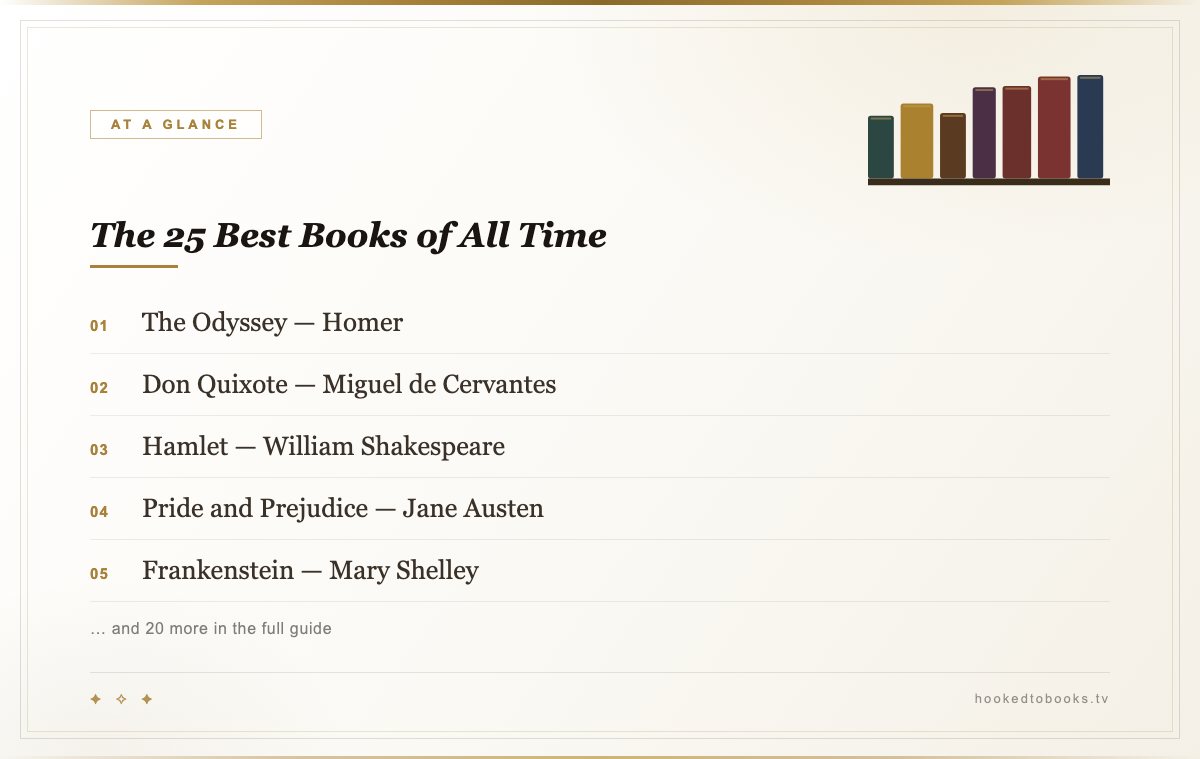
All 25 at a Glance
The Foundations
Three books that invented things the rest of this list depends on: the journey home, the unreliable hero, and the mind talking to itself on the page.
1. The Odyssey — Homer
Three thousand years on, it's still the most entertaining adventure story in the Western canon — a man lies, cheats and improvises his way home while the gods obstruct him for sport. The key is translation: Emily Wilson's is fast, plain and readable in a way the ornate Victorian versions are not, and it's the reason a lot of modern readers finally finished it. Start there and it reads like a thriller, not homework.
2. Don Quixote — Miguel de Cervantes
The first modern novel, and much funnier than its reputation suggests — an old man reads too much genre fiction, decides it's real, and drags a farmer along as his squire. What makes it endure is the second half, written ten years later, in which the characters discover that the first half has been published and people recognise them. Cervantes invented metafiction in 1615 and nobody has done it better since.
3. Hamlet — William Shakespeare
A play rather than a novel, and included anyway, because the interior monologue that half of this list runs on starts here. Hamlet is the first character in English who thinks on the page in a way that feels like actual thinking — circling, contradicting himself, talking himself out of things. Read it with a good annotated edition and the language stops being a barrier by act two.
The Nineteenth Century, Where the Novel Grew Up
The century that produced more of this list than any other. The novel became the dominant art form, and writers started using it to do things nobody had attempted: an entire provincial town's inner life, a whaling voyage as a metaphysical enquiry, a murderer's conscience in real time.
4. Pride and Prejudice — Jane Austen
Read past the romance and it's a sharp comedy about money, in which every character's options are dictated by an entailed estate and a shortage of eligible men. Austen's real achievement is free indirect style — the narration slides into Elizabeth's head without announcing itself, which is why you spend two hundred pages being as wrong about Darcy as she is. Still the most reread novel in English for a reason.
5. Frankenstein — Mary Shelley
Written by a teenager, and the source text for science fiction, the modern horror novel, and every “we built it before we asked whether we should” story since. The monster is articulate, well-read and profoundly lonely; the actual villain is a scientist who abandons what he makes. It has aged into relevance rather than out of it.
6. Jane Eyre — Charlotte Brontë
A first-person voice so direct it startled its first readers — a plain, poor, furious woman insisting on her own worth to a man who holds every advantage. The Gothic machinery in the middle is fun, but the reason it lasts is Jane herself, who refuses the terms she's offered even when refusing costs her everything. The most quietly radical book on this list.
7. Wuthering Heights — Emily Brontë
Worth reading precisely because it isn't the love story it's marketed as. Heathcliff and Catherine are destructive, cruel, and mostly awful to everyone around them, and the novel knows it — the whole thing is narrated at two removes by people who find the pair appalling. It's a book about obsession that never once endorses it.
8. Moby-Dick — Herman Melville
The most-abandoned great novel in America, and the abandonment is usually a pacing problem: readers hit the cetology chapters and quit. Give yourself permission to skim those and what's left is a wild, funny, genuinely strange book with the best opening chapter and the best final thirty pages of the century. Ishmael is excellent company; Ahab is a force of nature.
9. Great Expectations — Charles Dickens
The best entry point to Dickens because it's the one where he disciplines himself — tight plot, no wasted subplots, and a narrator who is ashamed of himself in a way none of his earlier heroes were. Pip's snobbery toward Joe is the most uncomfortable thing Dickens ever wrote, largely because it's autobiographical. The opening graveyard scene is a masterclass in how to start a novel.
10. Crime and Punishment — Fyodor Dostoevsky
A thriller that happens to be a philosophy seminar. You know who committed the murder from the first fifty pages, so the tension comes entirely from watching a man's own mind convict him — feverish, self-justifying, and unbearably tense. Read it in a modern translation (Oliver Ready's is excellent) and the nineteenth-century distance falls away almost entirely.
11. Middlemarch — George Eliot
Regularly called the greatest novel in English, and the claim is defensible: it takes an ordinary provincial town and gives every inhabitant an inner life as detailed as the protagonist's. Dorothea's disastrous marriage to Casaubon is the most acute portrait of a bad decision made for good reasons in all of literature. Long, slow, and worth every week it takes.
12. Anna Karenina — Leo Tolstoy
Two novels braided together: Anna's ruin, which everyone remembers, and Levin's slow, unglamorous search for a way to live, which is the half Tolstoy cared about most. The famous first line is a thesis the book then spends eight hundred pages complicating. Nobody has ever written crowd scenes, horse races or dinner parties better.
The Modernist Break
Then the form cracked open. Three books that abandoned conventional plot for something closer to how consciousness actually works — and one that did it in a Southern vernacular nobody had put on a page before.
13. Mrs Dalloway — Virginia Woolf
One day in London, one woman buying flowers for a party, and underneath it a shell-shocked veteran the novel keeps cutting to. Woolf moves between minds mid-paragraph, which sounds difficult and reads like eavesdropping. At under two hundred pages it's also the shortest way into modernism — start here rather than with Ulysses.
14. The Great Gatsby — F. Scott Fitzgerald
Assigned to teenagers who are ten years too young for it. The sentences are the point — Fitzgerald wrote at a level of prose compression almost no American has matched — and the story is a much colder indictment of the people in it than high-school readings suggest. Reread it at thirty-five and Nick's complicity becomes the whole book.
15. Their Eyes Were Watching God — Zora Neale Hurston
Out of print for decades and rescued largely by Alice Walker, which tells you how fragile a canon is. Janie's three marriages structure a novel about a woman assembling a self, and Hurston — an anthropologist by training — renders Black Southern speech with an accuracy and music no contemporary matched. The porch-talk passages are as good as American prose gets.
The Postwar Century
Books written in the shadow of two wars and the end of empire — and the one enormous fantasy that came out of the same trenches.
16. Nineteen Eighty-Four — George Orwell
Quoted constantly by people who haven't read it, which has slightly obscured what it actually is: a novel about the destruction of private language and private memory, with a bleak love story at its centre. The appendix on Newspeak, usually skipped, is the most chilling thing in it — and, read carefully, the most hopeful. Still the clearest book ever written about how states lie.
17. To Kill a Mockingbird — Harper Lee
Its reputation has been complicated, fairly, by later readings of Atticus and by Go Set a Watchman. It stays on the list because as a piece of craft it is close to perfect: a child's-eye narration that lets the reader see more than the narrator does, and a Southern town rendered with enough affection that its cruelty lands harder. Read it alongside Ellison and Morrison rather than instead of them.
18. Invisible Man — Ralph Ellison
An unnamed narrator moves through the American twentieth century — a Southern college, a Harlem political movement, a paint factory — and is misread by everyone at every stop. It's furious, surreal and very funny, and the prologue in the underground room full of light bulbs is one of the great openings. The novel that most deserves its place on every list of this kind.
19. Things Fall Apart — Chinua Achebe
Achebe wrote it in part as an answer to Heart of Darkness, and it works by refusing the argument entirely: instead of defending Igbo society it simply depicts it, in full, as a place with its own laws, cruelties and comedy. Okonkwo is a difficult, violent protagonist rather than a symbol. Two hundred pages, and it reset how the rest of the world read African fiction.
20. The Lord of the Rings — J.R.R. Tolkien
The book that created an entire commercial genre, written by a philologist who mostly wanted somewhere to put his invented languages. What holds up isn't the world-building — imitated to death since — but the tone: a story about small people carrying something too heavy, written by a man who survived the Somme. The last hundred pages, after the victory, are the part nobody else has ever dared to copy.
21. One Hundred Years of Solitude — Gabriel García Márquez
Seven generations of one family in a town that ants eventually reclaim, told in a voice that reports miracles and laundry in exactly the same tone. That flatness is the whole trick of magical realism and nobody has done it as well since. Keep the family tree bookmarked — everyone is named Aureliano and that is deliberate.
The Modern Canon
Four books from the last fifty years that already read like permanent fixtures.
22. Beloved — Toni Morrison
Based on the case of Margaret Garner, and structured so that the central act is withheld until you understand enough to sit with it rather than judge it. Morrison's prose does things at sentence level that almost nothing else here attempts — it's closer to poetry than to conventional novel writing. Difficult, and the most important American novel written in the last half-century.
23. The Remains of the Day — Kazuo Ishiguro
An English butler drives across the country in 1956 and tells you, in the most controlled and evasive voice in modern fiction, a story he does not understand about a wasted life. Every page is the narrator not saying something. The final scene on the pier is the most devastating thing on this list, and it's delivered entirely in understatement.
24. The Road — Cormac McCarthy
A father and son walk south through ash. McCarthy strips out quotation marks, most punctuation and nearly all backstory, and what's left is a book about parental love so concentrated it's almost unbearable to read as a parent. Short, and it will take you longer to recover from than to finish.
25. Wolf Hall — Hilary Mantel
Historical fiction is a genre that rarely gets onto lists like this, and Mantel forced the issue. Thomas Cromwell — the villain of every previous Tudor story — becomes a watchful, funny, dangerous man you follow through a present-tense narration that puts you inside the room. It takes fifty pages to get used to the pronouns; then it's the best historical novel ever written.
What We Left Off, and Why
Ulysses and In Search of Lost Time are both defensible picks for a top ten and neither is on here, because the honest answer is that most readers who start them do not finish them, and a list that recommends books nobody completes isn't useful. War and Peace lost its place to Anna Karenina on the grounds that if you're reading one Tolstoy, that's the one. And The Catcher in the Rye is a book whose reputation now rests almost entirely on when in your life you read it.
If you want a place to start, the fastest routes in are Things Fall Apart, Mrs Dalloway, and The Remains of the Day — all under 250 pages, all doing something no other book on the list does.
Keep Going
A list like this is only worth anything if it ends with you opening one of them. Pick the shortest one you haven't read and start tonight.
Want a free set of printable bookmarks?
We made a set for readers who actually finish their TBR pile. Print at home, cut, and slip one into whatever you're reading tonight — totally free.
Get the free bookmarks →As an Amazon Associate, we earn from qualifying purchases.