Best Books
Best Historical Fiction Books, by Era
Quick answer
Read All the Light We Cannot See by Anthony Doerr first. It won the Pulitzer Prize, it's accessible to readers who don't usually pick up historical fiction, and it's widely considered one of the best WWII novels of the last decade.
The 3-book shortlist: All the Light We Cannot See (WWII, the modern benchmark), The Song of Achilles by Madeline Miller (ancient Greece, won the Women's Prize for Fiction) and Wolf Hall by Hilary Mantel (Tudor England, won the Booker Prize).
As an Amazon Associate, we earn from qualifying purchases.
Good historical fiction does two things at once: it gets the period right and it tells a story you'd want to read even if it were set nowhere in particular. The nine books below are organized chronologically by the era they're set in, from the Trojan War to 1960s Mississippi, so you can pick based on which period pulls you in rather than wading through an undifferentiated "best of" pile.
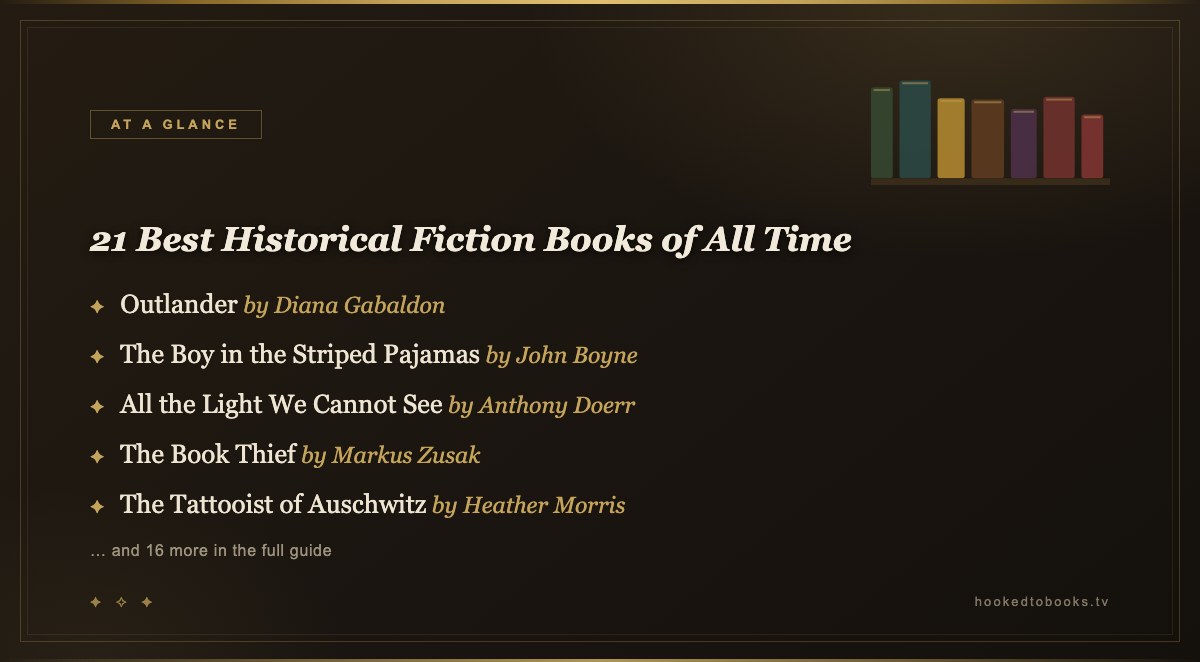
How We Chose
Every pick had to be set in a real historical period with real research behind it, not just a vague "long ago" setting, and had to have lasting critical reputation (a major award or a decade-plus of being recommended). We verified every author, year and setting against Wikipedia and Open Library as of October 2026.
All 9 picks, by era
| Book | Era covered | Published |
|---|---|---|
| The Song of Achilles | Trojan War, Greek Heroic Age | 2011 |
| The Pillars of the Earth | 12th-century England (1123–1174) | 1989 |
| Wolf Hall | Tudor England (1500–1535) | 2009 |
| Outlander | 1740s Scotland, with a 1945 framing story | 1991 |
| A Gentleman in Moscow | Soviet Russia, 1920s–1950s | 2016 |
| The Underground Railroad | Antebellum American South | 2016 |
| All the Light We Cannot See | World War II, France and Germany | 2014 |
| The Nightingale | World War II, occupied France | 2015 |
| The Help | 1960s Jackson, Mississippi | 2009 |
Ancient and medieval
1. The Song of Achilles by Madeline Miller
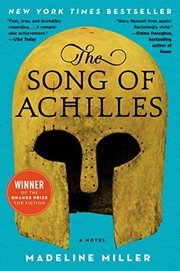
The Trojan War retold through Patroclus, the exiled prince who grows up alongside Achilles and loves him long before the war that will define both their names.
- Who it's for: readers who want mythology treated as genuine historical-feeling epic, with real emotional stakes rather than just gods and monsters.
- What it's like: lyrical, intimate first-person narration that makes a 3,000-year-old story feel immediate.
- Where to start: it's a standalone. The Song of Achilles (2011), winner of the Women's Prize for Fiction.
2. The Pillars of the Earth by Ken Follett
Spanning five decades of civil war in 12th-century England, the novel follows the builders, monks and nobles whose lives tangle around the construction of a great cathedral in the fictional town of Kingsbridge.
- Who it's for: readers who want a sprawling, multi-generational epic with real medieval detail about architecture, religion and power.
- What it's like: long (over 900 pages) and plot-dense, closer to a soap opera in the best sense than a literary novel.
- Where to start: The Pillars of the Earth (1989), followed by three further Kingsbridge novels.
3. Wolf Hall by Hilary Mantel
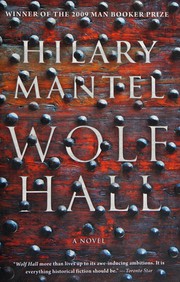
Thomas Cromwell's rise from blacksmith's son to Henry VIII's most powerful advisor, told from inside his own calculating, perceptive mind as the king maneuvers to break from Rome.
- Who it's for: readers who want the Tudor court done as serious literary fiction rather than romance-novel pageantry.
- What it's like: dense, present-tense, close-third narration that takes effort to settle into but rewards it completely.
- Series status: first of a trilogy, followed by Bring Up the Bodies (2012) and The Mirror and the Light (2020).
- Where to start: Wolf Hall (2009), winner of the Booker Prize.
18th and 19th century
4. Outlander by Diana Gabaldon
Claire Randall, a WWII-era combat nurse, touches a standing stone in Scotland in 1945 and wakes up in 1743, in the middle of Jacobite-era clan politics and a war she knows is coming.
- Who it's for: readers who want romance and time travel layered onto genuinely researched 18th-century Scottish history.
- What it's like: long, immersive, and unusually thorough about period detail (medicine, clan law, the Highland way of life) for a book that's also a time-travel romance.
- Series status: ongoing, 9 novels as of 2026. Full order: Outlander books in order.
- Where to start: Outlander (1991).
5. A Gentleman in Moscow by Amor Towles
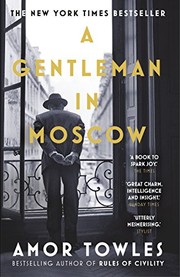
In 1922, Count Alexander Rostov is sentenced by a Bolshevik tribunal to spend the rest of his life under house arrest — inside Moscow's Metropol Hotel. The novel follows the decades that unfold within those walls.
- Who it's for: readers who want one confined setting to carry an entire sweep of 20th-century Soviet history, told with warmth rather than grimness.
- What it's like: witty, gentle and surprisingly moving, closer to a character study than a political novel despite its backdrop.
- Where to start: it's a standalone. A Gentleman in Moscow (2016).
6. The Underground Railroad by Colson Whitehead
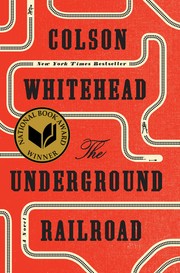
Cora, an enslaved woman in Georgia, escapes via the Underground Railroad — reimagined here as a literal network of tunnels and trains — and the novel follows her state by state as she's pursued by a relentless slave catcher.
- Who it's for: readers who want American slavery confronted directly, through a blend of historical realism and speculative invention.
- What it's like: structurally inventive (each state she passes through has its own distinct, almost allegorical society) and unflinching about violence.
- Where to start: it's a standalone. The Underground Railroad (2016), winner of the Pulitzer Prize and National Book Award.
20th century
7. All the Light We Cannot See by Anthony Doerr
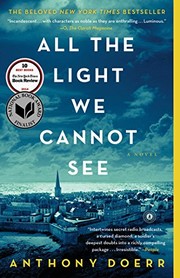
A blind French girl and a German boy conscripted into the Hitler Youth for his talent with radios have their separate paths converge during the Allied bombing of Saint-Malo in 1944.
- Who it's for: readers who want WWII fiction with lyrical, almost fairy-tale prose rather than straight war-novel grit.
- What it's like: short, alternating chapters that jump across a decade of buildup to converge at the siege itself.
- Where to start: it's a standalone. All the Light We Cannot See (2014), winner of the Pulitzer Prize.
8. The Nightingale by Kristin Hannah
Two sisters in occupied France choose very different forms of resistance against the Nazis — one hiding Allied airmen, the other smuggling Jewish children — and the novel is framed by one of them looking back from 1995.
- Who it's for: readers who want WWII seen specifically through women's resistance work, which gets less attention than the front lines.
- What it's like: emotionally direct and fast-moving, built for readers who want to feel the stakes rather than admire the prose.
- Where to start: it's a standalone. The Nightingale (2015).
9. The Help by Kathryn Stockett
In 1960s Jackson, Mississippi, a young white writer and two Black maids secretly collaborate on a book revealing what it's really like to work as household help for the city's white families — a project that could get all three of them hurt.
- Who it's for: readers who want the civil-rights-era American South told through intimate domestic relationships rather than courtroom or protest drama.
- What it's like: told in alternating first-person voices, warm and readable, though some readers and critics have noted it centers a white narrator's perspective on Black experience.
- Where to start: it's a standalone. The Help (2009).
If you only read one from each era
- Ancient/medieval: The Song of Achilles.
- 18th–19th century: A Gentleman in Moscow.
- 20th century: All the Light We Cannot See.
Want more on any specific series? See our Outlander books in order guide, or browse every list on our best book lists hub.
FAQ
What is the best historical fiction book of all time?
All the Light We Cannot See by Anthony Doerr, which won the Pulitzer Prize, is one of the most commonly named best historical fiction books of the modern era. For a classic, Wolf Hall by Hilary Mantel is the one most critics point to.
What historical fiction is set in World War II?
All the Light We Cannot See (occupied France and Germany) and The Nightingale (France under German occupation) are both set during WWII, from different angles.
Is Outlander historical fiction?
Yes, with a time-travel frame: a 1940s nurse is transported to 1743 Scotland, and the historical detail of the Jacobite era is extensively researched.
What historical fiction should I read about ancient Greece?
The Song of Achilles by Madeline Miller retells the Trojan War through the relationship between Achilles and Patroclus, and won the Women's Prize for Fiction.
What is a good historical fiction book about American history?
The Underground Railroad by Colson Whitehead (Pulitzer and National Book Award winner) and The Help by Kathryn Stockett both cover different eras of American history, from the antebellum South to 1960s Mississippi.
Nine books, nine different centuries. Start with All the Light We Cannot See, or jump straight to the era that pulls you in.
Want a free set of printable bookmarks?
Made for cozy readers working through a long series in order. Print at home, cut, and slip one into whatever you're reading tonight. They're free. Then browse all our reading-order guides.
Get the free bookmarks →As an Amazon Associate, we earn from qualifying purchases.